




What We're Reading Now
Building Community Through Conversation
26 May 2026
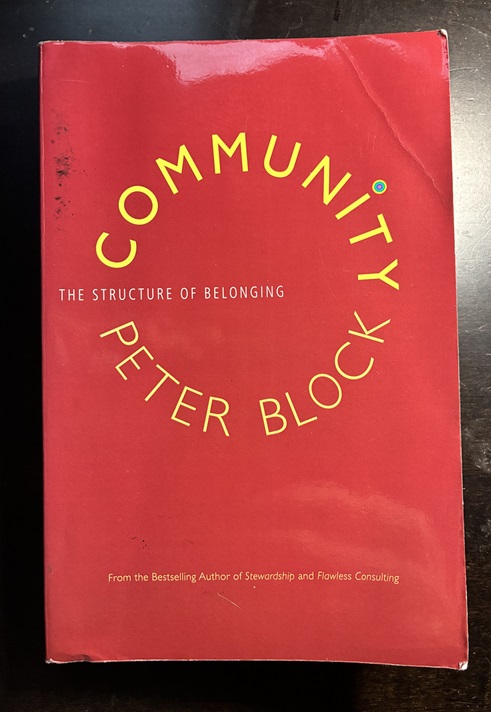
Geof read Peter Block’s Community: The Structure of Belonging and came away with a deeper appreciation for how transformation happens, not through big plans or distant authority, but through the conversations that create belonging, accountability, and shared possibilities.
Tags: communication, geof read, leadership, listening
About ten years ago I was supporting a leadership transformation program that had Peter Block as one of the central expert consultants. While I’d be honored to say we were partnering on the project, I was more bookending his work. For those who aren’t familiar, Block’s work centers on cultivating community through accountability. He defines community as “social connection through conversations that create belonging and collective agency.” More than a group, a community allows individuals to experience relatedness, shared responsibility, and the capacity to co-create an alternative future. Each of these is critical to transformation.
The group we were working with were senior leaders from around the world. Block had just finished leading an exercise, and one of the participants asked, “what are we going to do next?” Block politely deferred to the group, (and I’m paraphrasing) by saying “Rather than wait for someone to tell you what to do, I’m going to step out of the room, get myself a cup of coffee from the cafeteria, and when I return you will tell me what we are going to do.” The group was energized by the invitation.
What I realized (with great appreciation these ten years later) after reading Block’s book, Community: The Structure of Belonging, is that transformation through community is not built by big plans or distant leaders; it is created one room at a time, through the quality of the conversations we hold. This philosophy, drawn from the core ideas of Community, invites us to rethink how social transformation happens, not as a top-down process but as a bottom-up, grassroots practice of belonging, responsibility, and possibility.
From Stuck to Restorative
Many communities today feel stuck in a cycle of fear, blame, and isolation. This "stuck community" is marked by leader-centric, paternal problem-solving mindsets, and the citizens cast as each consumer or critic. In contrast, Block introduces “the restorative community,” which chooses generosity over scarcity, possibility over prediction, and accountability over control. It is a community where everyone’s gifts are recognized. Real community occurs when people move beyond transactional interactions to accountability, generosity, and recognition of each other's gifts.
Citizenship as a Practice of Freedom
True citizenship in a community is about a willingness to take responsibility for the whole. It means seeing oneself as a cause or contributor to the current state, acting without any expectation of return, and bringing marginalized gifts into the center. Citizenship becomes an engine of change, fueled by accountability and contribution. Think of Kennedy’s famous quote, “Ask not what your Country can do for you, but what you can do for your Country.”
Leadership as Convening
Leadership in this framework is about convening rather than controlling. With community, the leader’s job shifts from top-down direction to naming the situation and context, designing gatherings and conversation that embody the future we want, and listening. They create conditions for stakeholders (citizens, coworkers, or colleagues) to step into ownership and collective agency. These groups foster accountability and discovery of shared concerns, surfacing diverse perspectives and sharing ownership across the community.
Six Conversations That Build Belonging
In the book, Block introduces “The Six Conversations” (these are the foundation of the work I observed ten years ago). The conversations serve as a process that transforms isolated individuals into a connected, empowered community capable of co-creating a shared future. Each conversation plays a distinct role in moving people from separation and blame toward mutual responsibility, generosity, and authentic inclusion. The conversations include:
- Invitation: Creating a freely chosen, personal invitation that clearly states the possibility at stake. It acknowledges the hurdles to transformation and makes refusal acceptable, intentionally bringing together people who might not usually gather.
- Possibility: This conversation is a public declaration of a future distinct from the past. It begins with sharing personal crossroads that help to energize the community. The public declaration reinforces accountability.
- Ownership: Ownership moves the conversation from blame (i.e., stuck) to responsibility. It asks how individuals have contributed to the conditions they complain about and surfaces the stories and payoffs that sustain those conditions.
- Dissent: Dissent safely makes room for doubts, refusals, and resentments. It distinguishes authentic dissent from denial, rebellion, and resignation, clearing the way for genuine commitment.
- Commitment: Commitment is a promise made without expectation of return. It is most powerful when made to peers and must allow refusal without loss of membership. If one refuses a commitment, they are still free to engage with the community.
- Gifts: Conversations focused on gifts shift attention from deficiencies to capacities. They make the group more inclusive by highlighting each member’s gifts. And by each, Block means that every member has a gift to include.
The Power of Questions and Creating Space
Each of the six conversations is rooted in questions. Questions hold transformative power beyond answers. Effective questions are ambiguous and open ended, personal and relevant, and uncomfortable, confronting people with their freedom and inviting ownership and co-creation.

Rather than rushing to solve or answer questions, the leader’s role is creating space for these questions resonate. Rather than solving, leaders allow deeper reflection and collective insight to emerge. This approach replaces advice with curiosity and shapes the context in which possibilities unfold.
Creating space means resisting the urge to fix or close conversations prematurely. It involves holding open the tension of uncertainty and inviting participants to explore their own meanings and commitments. This practice fosters trust, deepens engagement, and nurtures the emergence of new possibilities that cannot be anticipated or prescribed.
Together, the six conversations and the practice of asking powerful questions within spacious, hospitable contexts form the foundation for accountable, generative community building.
A Moral Commitment Beyond Outcomes
Finally, Block’s philosophy of community calls for us to act without an emphasis on results. This seems counter-intuitive, but focusing too much on outcomes can lead to coercion, control, and a transactional mindset that undermines trust and generosity. Instead, he encourages acting with generosity and accountability for their own sake, valuing the quality of relationships and individual commitments. This approach allows belonging and collective agency to emerge organically without the pressure of predetermined results, fostering a more authentic and sustainable community.
Community is an inspiring and actional “playbook” for anyone that feels stuck in engaging with others to create transformation, in their work communities, social communities, or at home.


Comments
Our Comment Policy:
Our blog posts are only half of the conversation. What our readers have to say is equally important to us, and we're grateful for all the comments that continue the dialog.
To ensure that the discussion here is as useful as possible to all of our readers, please be respectful of our contributors and refrain from harassing, threatening and/or vulgar language. We reserve the right to screen and remove any comments from the site. If you have a question about a comment or want to discuss our policy, please contact us. We'll talk it over.
There are no comments for this entry yet.