




What We're Reading Now
Learn to Love Writing
20 January 2026
Barbara read The New York Times obituary for Peter Elbow. She never met him, but he was one of her favorite teachers who helped her become a better and happier writer.
Tags: barbara read, barbara watched, freewriting, writing
I was reminiscing about my favorite writing professor, Peter Elbow, whom I never met, and suddenly found myself wondering— Is he still alive? I discovered he died February 6, 2025, and was so pleased to learn The New York Times wrote his obituary. I am always fascinated by who they decide to write about and appreciated this explanation of the criteria.
Elbow was a scholar, violinist, snow skier, and prolific writer, but his writing life had a start that comforts me. His obituary said, “While he originally intended to become a professor of literature, he suffered a debilitating case of writer’s block almost as soon as he arrived at Harvard in 1959 to study Chaucer in pursuit of a doctorate….”
He had completed his Masters at Oxford so he certainly had academic chops, but at Harvard, he said “I had a terrible time getting my first-semester papers written at all, and they were graded unsatisfactory….I could have stayed if I’d done well the next semester, but after only a few weeks I could see things were getting worse rather than better. I quit before being kicked out.”
I had similar feelings, though not as dramatic, when I was an undergraduate English major at the University of Richmond with a term paper for every class. I never knew why I got an A or a C. I just prayed for Bs. All my professors used to talk about writing multiple drafts. I would stare at them and laugh on the inside. As I typed fast on my portable electric typewriter the night before a paper was due, I’d think—You are lucky to get this draft. There’s no time for multiple ones. I did get enough Bs to graduate well and much to my surprise years later, I missed reading and writing papers.
After auditing a course in the religion department at UNC Charlotte, I realized that going to school made me happier than any other extracurricular activity I had tried after my children were born. I first took Literature of the American South in the fall of 1977. And then I thought I must take a writing class to wrestle this demon to the ground and find out why I never know how a professor will react to what I write. In the spring I took Rhetoric taught by Dr. Sam Watson who would become the best teacher I ever had in an academic setting. Writing Without Teachers by Peter Elbow, which had been published in 1973, was the main text.
After Elbow dropped out of Harvard, he did odd jobs including teaching at MIT, but then he returned to graduate school at Brandeis University for his PhD. He wanted to find out why he had so much difficulty with writing. He said, “I made myself a rule: Every time a paper was due, I had to have a draft of the same length as the paper done a week before…. So then I knew I had a week to play with it.” I have lived that way ever since graduate school, and I didn’t remember that I learned that process from him. However, one quote from his first book, I’ve never forgotten: “Garbage in your head poisons you. Garbage on paper can safely be put in the wastepaper basket.”
Many sources said he revolutionized the teaching of freshman composition when he wrote Writing Without Teachers which emphasized a process call freewriting—write nonstop for ten minutes without worrying about spelling, punctuation, grammar, content, or anything some English teacher told you to worry about. “One of his students told The Times in 1983, ‘The first time I was given a free-writing exercise, I didn’t know what to do with it….There was a feeling that this can’t go on too long. But after the first few times, the exercise began to make sense, and writing became a little bit easier.’”
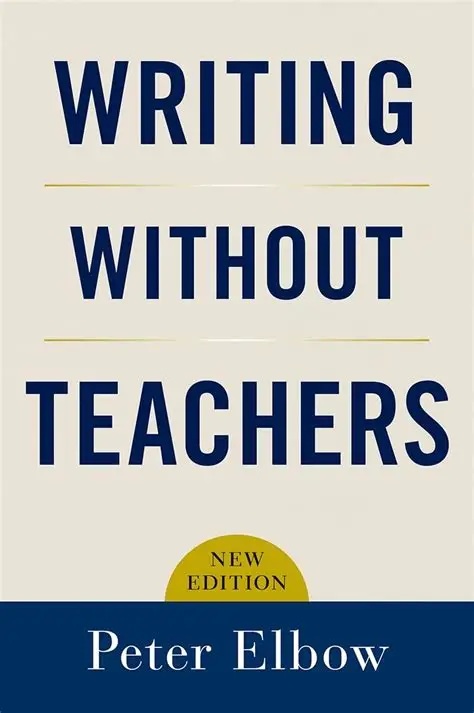
Freewriting revolutionized my life when I read his book and was required to write nonstop for 10 minutes every day by Dr. Watson. I finally had the answer to how to make my writing not just better but also easier. I no longer dreaded writing or agonized while I was trying to get something meaningful written. I do still feel fuzzy headed and even lethargic when I start to edit, but he taught me the importance of separating the judgment of editing from generating words for early drafts.
It also helped me solve personal and work problems, and to just have a better day. In this post, my daughter Allison explains why and how we encourage clients to freewrite each morning before they check email, read the paper or social media, or engage with anyone other than helping themselves and family members to get ready and out the door.
After I read the NYT obituary, I read the family obituary and watched his funeral service. In the family obit, I learned, “He chose his boarding school (Proctor Academy in New Hampshire) because skiing was compulsory. He chose Williams College in Massachusetts because it had a good ski team – but not so good that he couldn’t get on it.” He played the violin in symphonies wherever he lived, and in his retirement community played regularly for people in Assisted Living. He loved to practice the violin because it meant figuring something out.
The funeral began with many photos of him skiing and being with his family. He was a Quaker so to honor his tradition, they began the service with five minutes of silence. A lot of people described his special ways of making deep friendships. He had lunch with one friend weekly. With another he had a regular hour call, and they each spoke for a half hour without interruption about whatever was on their minds. I’d always been grateful for what he and Dr. Watson taught me, but after watching the service I felt I knew him intimately.
Twice there are sound problems in the video, but if you decide to watch the service, after the rotation of pictures which are wonderful, scroll through to the end and listen to his children talk about him.
The daughter said he was an optimist believing things can be good no matter what is going on around you, and we don’t have to be stuck in the old ways. He was a rule breaker. He never walked by a Do Not Touch sign without touching the thing.
His son spoke last. He said, “I’m probably going to cry, which I don’t really like to do, but Dad really liked a lot. Most people think there are no simple solutions. Complex problems require complex solutions, but that’s not the way my dad saw the world. No matter what the problem was, the solution was pretty simple. It was— just freewrite more.” I laughed out loud because I completely agree and have followed that advice for over 30 years.


Comments
Our Comment Policy:
Our blog posts are only half of the conversation. What our readers have to say is equally important to us, and we're grateful for all the comments that continue the dialog.
To ensure that the discussion here is as useful as possible to all of our readers, please be respectful of our contributors and refrain from harassing, threatening and/or vulgar language. We reserve the right to screen and remove any comments from the site. If you have a question about a comment or want to discuss our policy, please contact us. We'll talk it over.
There are no comments for this entry yet.