




What We're Reading Now
How to Human
9 December 2025
Rachel has been reading and thinking and reading and thinking — a lot — about learning and teaching lately. Inspired and informed by the work of Brené Brown, Carlo Rotella, and others, she's circling around new awareness of how we equip leaders (and ourselves) to harness our human-ness.
Tags: design thinking, leadership, learning, mindfulness, rachel read
Back in August, I was randomly scrolling when an interview clip stopped me in my tracks. Brené Brown was talking about her soon-to-be-released book, Strong Ground: The Lessons of Daring Leadership, The Tenacity of Paradox, and the Wisom of the Human Spirit, and said, "I don't think, in this moment, that we're very good at what makes us human." It resonated in that quiet and still way that truth sometimes does, especially when I thought about the MBA students, business leaders, and community members that I watch navigate their lives and responsibilities.
So I got the book and started reading, and smiled at the sports metaphors (and her narrated inner dialog about them), and thought about what I wanted to do about it.
Fast forward to two weeks ago, when I passed by but then returned to an OpEd piece by Carlo Rotella in the New York Times: "I'm a Professor. A.I. Has Changed My Classroom, but Not for the Worse." (I first scrolled past, rolling my eyes and thinking to myself, "Duh. I'm so tired of people scapegoating A.I. or using it as clickbait." I don't know what changed my mind, but I'm glad.) Rotella teaches English Lit at Boston College, and I found myself nodding along as I read his philosophy of teaching and some principles of building "an A.I.-resistant English course." I saw the best version of myself in his description: "I don't lecture much. Mostly, we engage in conversation, paying attention to one another and to the book we have all read. I don't teach content so much as a way of coming at things — tools and moves we can use to extract meaning from the world around us and make well-supported arguments about what we find."
I don't teach English Lit, but I do teach problem solving and design thinking and other "squishy" topics of leadership, and there are parallels. I encounter people who crave a fixed model or tool or answer wrapped up in a piece of content, only to discover that the complexity and pace and nuance of the world requires instead that we piece things together to make meaning. To me, that's the "human" in a world where A.I. and a search engine can provide nearly any answer imaginable. Rotella suggests that one implication is that we shift a greater portion of our attention to what happens in the rooms and spaces that we gather, and on the exchange of meaning that we can foster.
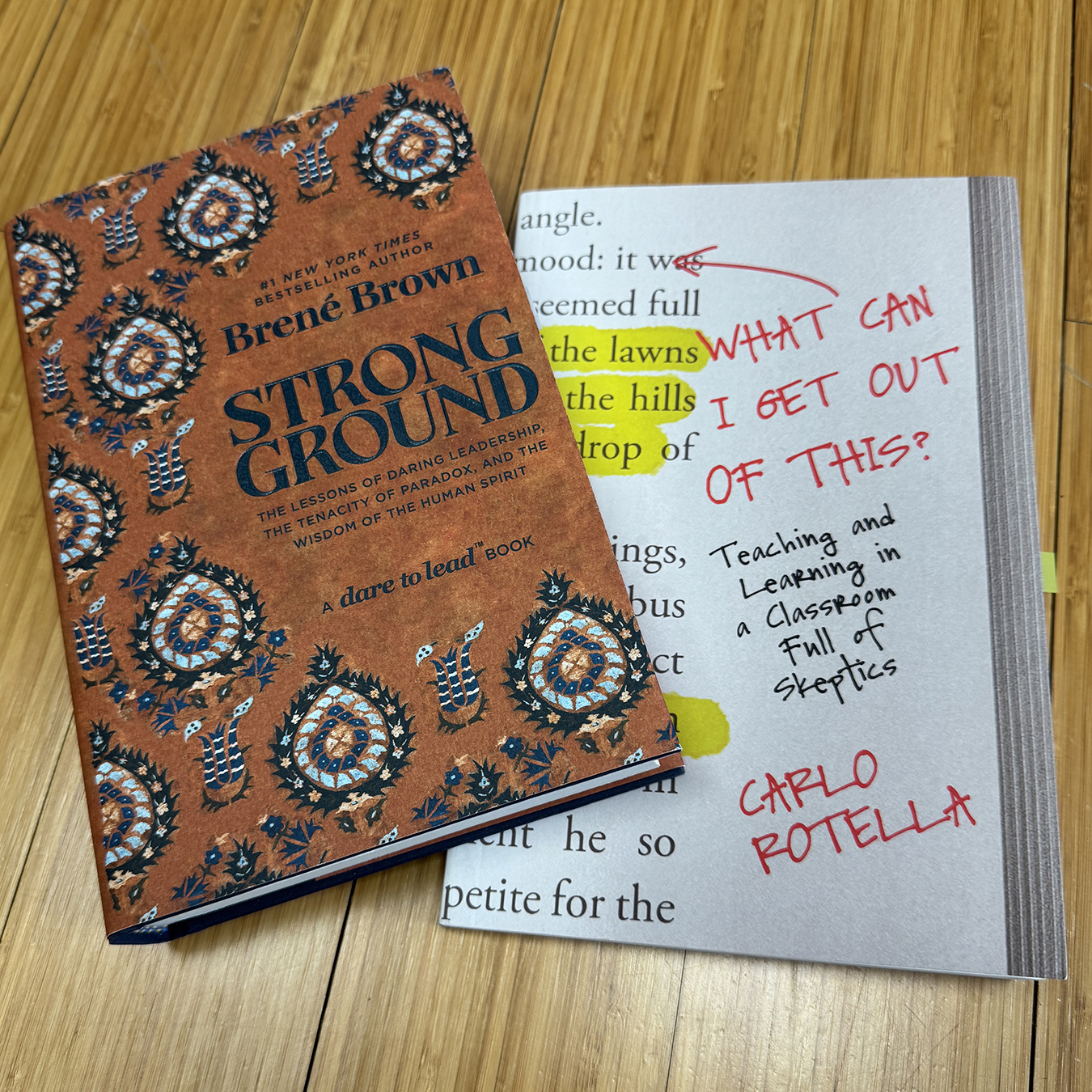
I'm spending a lot of time these days developing leadership curricula, and the voices of Brown and Rotella have been loud in my mind, urging me to resist some of the temptation for content and clear direction in order to encourage others to notice nuance, consider, and wayfind. I believe that A.I. is neither a passing fad nor the villian of our human story — discovering how we learn and lead with all of our human-ness seems like a worthy undertaking.
P.S. Rotella wrote more about his experience teaching college freshman in What Can I Get Out of This? Teaching and Learning in a Classroom Full of Skeptics. I was laughing out loud by the second page, and making notes in the margins before I left the preface. More to come.


Comments
Our Comment Policy:
Our blog posts are only half of the conversation. What our readers have to say is equally important to us, and we're grateful for all the comments that continue the dialog.
To ensure that the discussion here is as useful as possible to all of our readers, please be respectful of our contributors and refrain from harassing, threatening and/or vulgar language. We reserve the right to screen and remove any comments from the site. If you have a question about a comment or want to discuss our policy, please contact us. We'll talk it over.
There are no comments for this entry yet.