




What We're Reading Now
Antidote to Technology Harm
27 October 2026
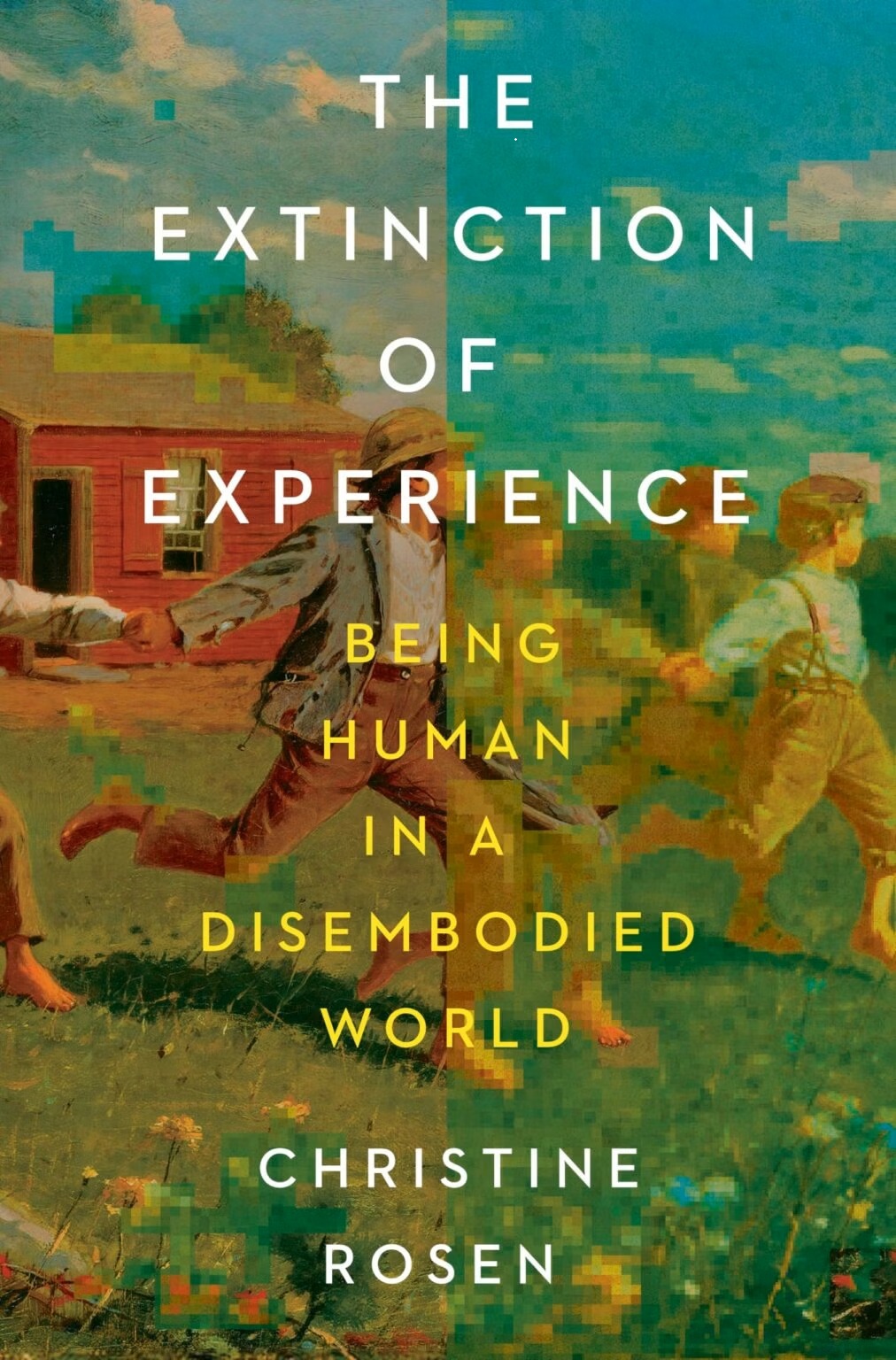
Barbara read The Extinction of Experience: Being Human in a Disembodied World by Christine Rosen and learned sobering details about what the digital age might be doing to us.
Tags: barbara read, writing
Rosen said computers, smart phones, and now AI have caused us to give up real life experiences that use our body. Writing (especially cursive) is not taught, architects use computers for drawing, many of us, especially the young, are no longer making eye contact. Heads are bowed looking at phones. Waiting and boredom are problems to be fixed as fast as possible, not something to endure or enjoy. As a result, we have become more impatient, often filled with rage. Rosen points out the harm technology can do, but it is up to us to find ways to reduce or stop that harm altogether.
She presents much research to prove her points. “A study conducted by Virginia Berninger at the University of Washington examined 700 elementary school students in Seattle, 144 of whom were struggling with reading and writing. After dividing the students into groups and testing various remedial activities to improve their performance, the researchers found that one group was far superior: those who had spent the most time working on their handwriting.”
Practicing handwriting not only helped them learn to read, but it also helped them focus and remember what they had read. Swiping left and right or touching a screen does not get the same result. She recommends that children learn print and cursive before they learn to use a keyboard.
Immediately looking at phones lessens access to creativity. Rosin quoted, “Novelist and technologist Robin Sloan noted in an interview that when he realized his use of the iPhone was encroaching on his interstitial time, he stopped using it when he was standing in line or on the train. ‘I’ve been daydreaming more, jotting down scraps of stories again,’ he said.”
Humans, especially babies, need interactions with other humans. Rosen gave a dramatic example: Patricia Kuhl of the Institute for Learning and Brain Sciences at the University of Washington did experiments to see how babies learned language. She “…tested whether it would make a difference if the babies heard words directly from a human being or from an audio recording or video.” The study showed they only learned language when they were spoken to by a person.
Our bodies pick up signals when we are in the presence of another person that they do not on Zoom. We can interpret emotions when we are looking at each other even if we don’t have the words to express them in the moment. We can sense when someone is angry, sad, or just a little off.
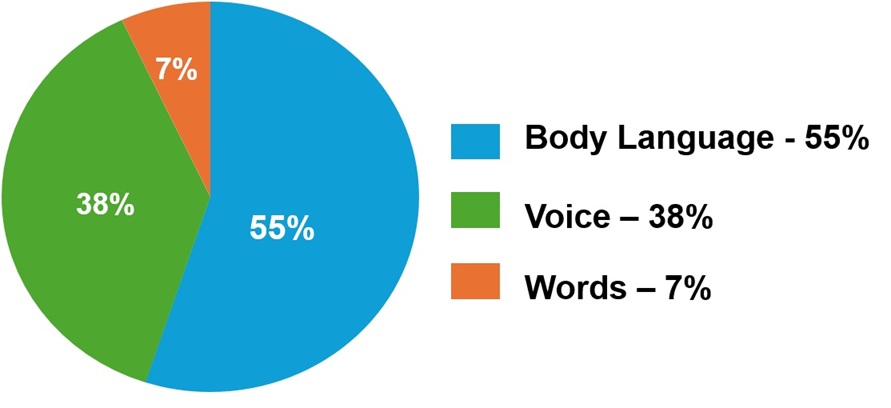
When I taught for the American Association for Physician Leadership, I presented Psychologist Dr. Albert Mehrabian's research suggesting that when people interpret feelings and attitudes, especially when spoken words conflict with nonverbal signals, tone of voice and facial expressions can have a powerful influence on how a message is understood. He said 7% depends on the words, 38% on the tone of voice, and 55% depends on what we do with our bodies.
Physicians often looked at me with doubt because I was using percentages, but then I’d say, “If that is hard to believe, if you don’t trust the numbers, let me do a demonstration for you that might convince you of the concept. Then I’d slam my hand down on the table and yell, “ I am not angry!” They gave up the debate. They were immediately convinced body language and tone of voice matters most and told a powerful story that could not be overcome with words alone.
We can also read body reactions and voice tones that are much more subtle than my demonstration, but you have to actually be with the person to detect them, and this is part of what I think worries Rosen about our dependence on technology
As I read, I wanted to rationalize that the new technologies are not as harmful as she predicted because I love so much of what she said was bad for us. I worked remotely starting in 1990 long before COVID-19 made that way of working a necessity. The office was in Tampa. I lived in Orlando. I went to the office for two days once a month to talk with my boss and interact with coworkers. We didn’t have Zoom, but I talked on the phone regularly with my colleagues when I was in my home office. I am an introvert and I adored working from home. I often said, “If I was in the office all the time I wouldn’t be able to get enough work done to keep my job."
GPS allows me to go places I wouldn’t even consider if I didn’t have it. I have little round robots that vacuum my house every week, an Apple watch that will call 911 if I fall, a Honda that tells me I need to take a break when I’m driving home from my son’s house in Durham. I read Kindle books that are projected onto a 24” monitor so I can stare straight ahead rather than always looking down, and in the last two years I started to ask ChatGPT to answer all kinds of questions. I check AI sources and discuss what I learn with my daughter before taking action, but I love how AI is helping me to research. Online shopping simplifies my life. I’ll shop at five stores for something, can’t find it, come home, order it from Amazon and have it the next day. That is hard to give up.
I taught my grandchildren cursive, and I’ve sent them hand-written notes. I write letters to them, but if it is a long letter, I write it sloppily first in my journal and then type it because I don’t want to use my hands to write it again in a neat, readable long hand.
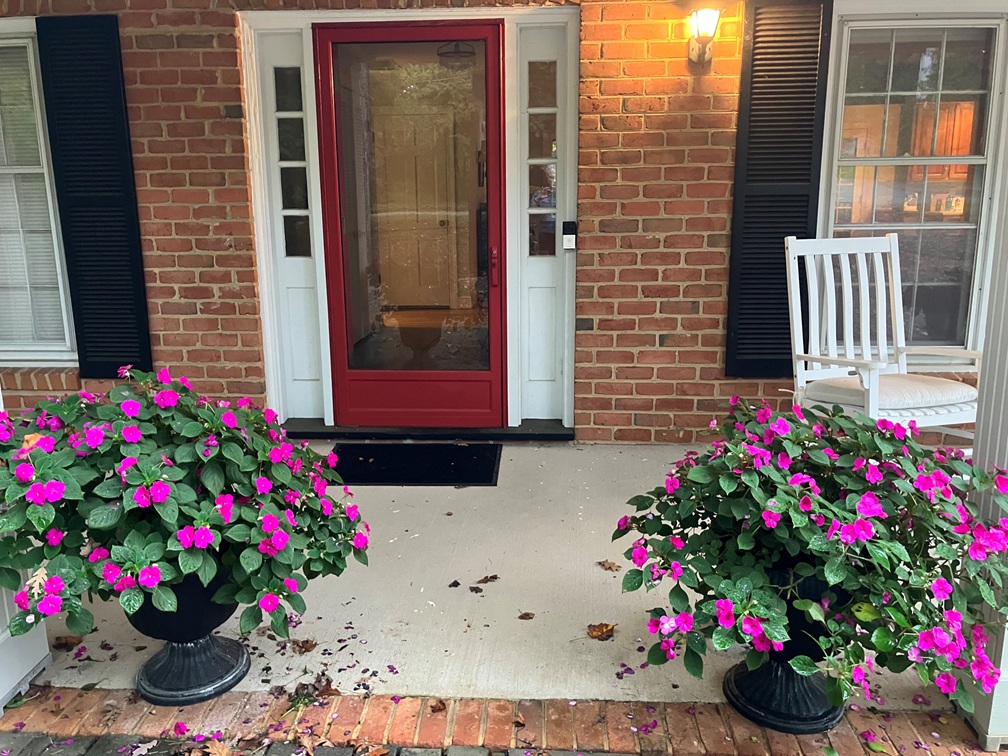
my beautiful hot pink impatiens
As an antidote to a lot of screen time, I go outside and look at the sky, trees, and my beautiful hot pink impatiens. I listen to the birds, but I also love my Merlin app which tells me who is singing. I write in cursive three “morning pages” every day in a journal, oil paint on the weekends, and make quilts. I get together regularly with my daughter and my friends. I talk on the phone with my son and love texting with my grandchildren. Following them on Instagram has given me insight into their lives I thoroughly enjoy. I am hopeful all these things will keep me grounded as technology propels us quickly into a future we are unsure about.
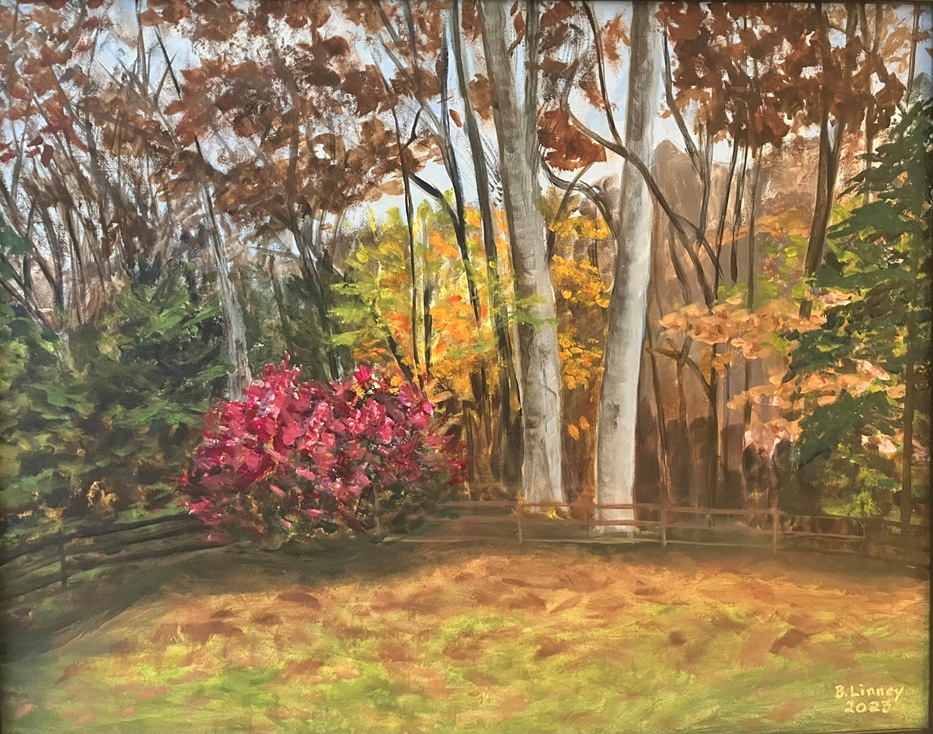
my painting of my backyard
Rosen says, “Arriving at oneself, figuring out who you are, what you love, what you think about your world and the people in it—these are experiences that require time, patience, boredom, daydreaming, and anticipation to discover.” I completely agree. However, if I ever met her, I would argue that the priests thought the printing press was a terrible invention because everyone could have access to their knowledge. However, I’d argue they needed to lose control of that knowledge and the printed word turned out pretty well for the rest of us. I want to believe all of today’s digital conveniences can be like the printing press. I know Rosen would say that’s naive, and I’m worried she is right.
But my mother, Ruby Lee Johnson, who was a business teacher, embraced every new technology, and it never impacted her wish to be with people. Technology expanded her world and then she brought those insights to all of us. I’m grateful she taught me not to be afraid of technological advancements, and I’m certain the fact that our home had the first personal computers helped our children to succeed.
I’m glad Rosen is raising these serious concerns. I believe her warnings can help us to make better choices about how and when we use technology and remind us that we need to be intentional about being with other people, putting our phones down, and getting outside.


Comments
Our Comment Policy:
Our blog posts are only half of the conversation. What our readers have to say is equally important to us, and we're grateful for all the comments that continue the dialog.
To ensure that the discussion here is as useful as possible to all of our readers, please be respectful of our contributors and refrain from harassing, threatening and/or vulgar language. We reserve the right to screen and remove any comments from the site. If you have a question about a comment or want to discuss our policy, please contact us. We'll talk it over.
There are no comments for this entry yet.