



What We're Reading Now
Making Meetings More Bearable
1 September 2026
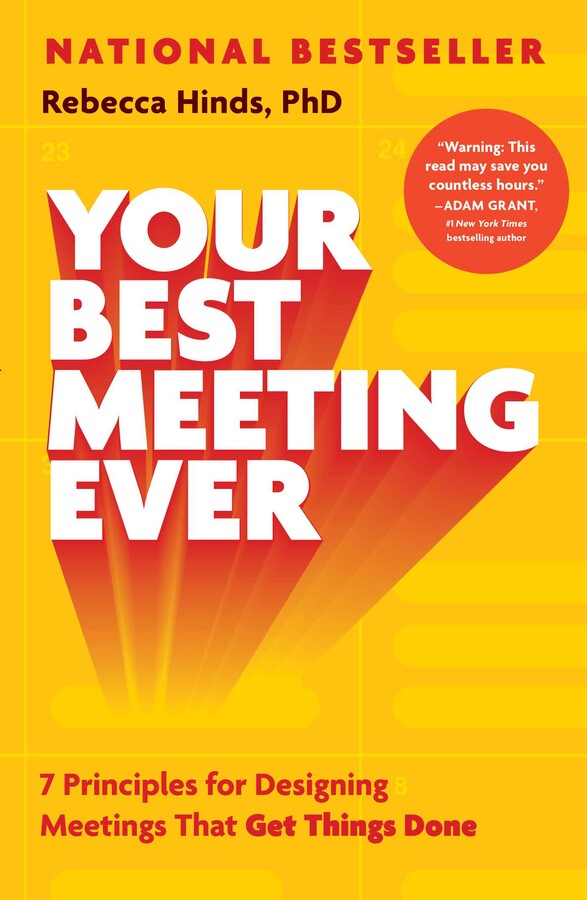
Barbara read Your Best Meeting Ever: 7 Principles for Designing Meetings That Get Things Done by Rebecca Hinds, PhD, and learned how to have fewer meetings, make them shorter, and get more out of the ones that remain.
Tags: barbara read, meetings
Rebecca Hinds, PhD, began her book with a humorous description of how meetings were designed to be confusing and accomplish nothing as a maneuver for people living in enemy territory to help win World War II. The Office of Strategic Services wanted to "turn meetings into productivity sinkholes, where time, energy, sanity, and brain cells go to die….What was once a wartime sabotage tactic now reads like a modern meeting."
Her first recommendation to her clients is to have a calendar cleanse and cancel all meetings for 48 hours. Then only add back the meetings that are absolutely essential. Not every organization will do it. Leadership has to be on board, or it will not work. My boss for 22 years would not have agreed to something so extreme. However, he already had a strict rule that meetings could not be longer than an hour and his office was close enough to the conference room to know if too many meetings were happening. If he thought we were wasting our time, we’d hear about it.
Hinds covered every single behavior I’ve seen that ruined a meeting from a jerk boss to a leader with no organizational skills to overuse or misuse of AI tools. She is a PhD with all three degrees from Stanford, and she left no research stone unturned which may be helpful if your organization requires proof to try out her ideas. I’ll describe the lessons from the book that grabbed me and start with one that made my heart soar.
Brainwriting
She described a process called Brainwriting that should be done before a Brainstorming meeting. "Everyone writes down their ideas independently and silently before sharing them with the group." If you don’t do this, "Loudmouths dominate the room. Overthinkers freeze under pressure. And group think takes over as people nod along instead of speaking up….brainwriting groups generate 20 percent more ideas and 42 percent more original ones compared to traditional brainstorming groups."
I have been asking people in all the groups I’ve led for years to write quietly before they talk, and I loved having research validate for the business world what one of my English professors taught me in graduate school. Brainwriting is also the first step in one of my favorite tools for problem identification and solution generation, Nominal Group Technique.
Lateness
Don’t ignore lateness. Hinds said it is "…a slow leak in the meeting’s energy, pace, and purpose." My boss, who taught me his course on Effective Meetings, so I could take it on the road to our healthcare clients, told me a story about when he was teaching. He said, "I had a participant come into one of my classes and say, 'For the benefit of those of us who were late, will you catch us up?'" He told them, "There is no benefit for being late." And then he looked me in the eye and said, "When you teach this course, never catch latecomers up. Carry on as if they didn’t exist." I did what he told me.
Hinds gave two examples of how organizations stopped lateness. A Venture capital firm had "partners pay ten dollars for every minute they’re late to founder meetings." Another put a glass in front of every participant’s seat with their name on it. If they’re on time, they drop in a green marble, if they’re late, a red one. In a month as the red marbles increased in their jars, the chronic late comers were embarrassed and stopped that behavior. I’m not a big fan of embarrassment as a way to deliver feedback, but I imagine that for some organizations this kind of competition would be effective.
Sound Quality
People need to be able to hear you without straining to do it. No matter the setting—in person, on Zoom, in a large conference room, or one-on-one—do what it takes to be heard. Hinds told many stories of failed equipment when on-line meetings began in the Pandemic. She said, “If they can’t hear you, they won’t trust you….Researchers had shown that when sound quality degrades, listeners don't just find the content harder to follow. They rate the speakers as less intelligent, less likable, and less credible.”
15-Minute Huddles
When Dr. Tom Mihaljevic took over as CEO of the Cleveland Clinic, he needed to know what serious issues were happening in his system every day. "With 77,000 employees spread across hospitals from Ohio to Abu Dhabi, he faced a massive challenge: staying on top of daily operations without getting tangled in the weeds." He came up with"a tiered system of fifteen-minute daily huddles designed to escalate urgent issues from the frontline to the CEO within twenty-four hours. It worked like a relay race. The process kicked off with short daily meetings between caregivers and their managers to flag pressing issues. If an issue couldn’t be resolved on the spot, it moved up the chain to the next leadership level. This continued through six tiers of meetings, each happening sequentially, until only the most critical matters reached (his) desk."
Other companies Hinds worked with that were not life and death environments found a weekly 15-minute huddle was all they needed to lessen long update meetings.
Stories
Stories are a great way to present information if they are not too long. To get employees excited about the product they sold, a flooring company created a short and poignant one: '[Flooring] is the first thing your feet touch in the morning and the last thing they leave before you fall into bed at night… It’s where babies sit as they marvel at banging pots and pans. Where stubborn toddlers stomp their feet. Where aspiring, young ballerinas twirl… Flooring matters." I loved that story and I’ve thought about how I appreciate my own hardwood floors many times after reading that story. I also remembered how ceramic tiles in the kitchen and everywhere except the bedrooms made my legs ache when we lived in Florida.
Phones
Leaving phones at the door or putting them in the middle of the table with sound and vibrations off can improve meetings and make them shorter. People’s desire to get them back can shorten the meeting because everyone will be succinct rather than rattling on.
AI
Hind’s list of what AI can do in a meeting goes on and on: record every word, summarize what was said, assign tasks to the appropriate people, detect when people’s energy is sagging and they are bored, fix the agenda for the next meeting. Some of them sound great and others sound like they would be more disruptive than supportive and might even keep people from participating fully especially if agenda topics are sensitive or controversial. If you would like to use AI tools, they should be discussed with all participants before you start using AI in the meetings. It’s also important to be careful. In one organization someone left AI on after a meeting had ended, but several people kept talking and said disparaging things about the others in the meeting. A deal and trust were lost.
If you or others in your organization require research to prove that these meeting techniques work, then Hinds has written the book for you. However, overall, I found the book to be a bit too detailed for most readers.


Comments
Our Comment Policy:
Our blog posts are only half of the conversation. What our readers have to say is equally important to us, and we're grateful for all the comments that continue the dialog.
To ensure that the discussion here is as useful as possible to all of our readers, please be respectful of our contributors and refrain from harassing, threatening and/or vulgar language. We reserve the right to screen and remove any comments from the site. If you have a question about a comment or want to discuss our policy, please contact us. We'll talk it over.
There are no comments for this entry yet.