



What We're Reading Now
Wisdom to Help You Write Better Sentences
12 May 2026
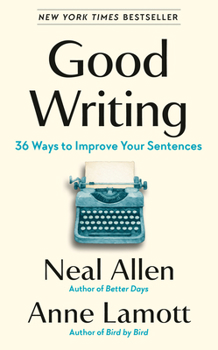
Barbara read Good Writing: 36 Ways to Improve Your Sentences by Neal Allen and Anne Lamott and learned some encouraging help for editing second and third drafts of any kind of writing—essays, memos, emails, articles, stories, and poems.
Tags: barbara read, freewriting, writing
Anne Lamott has been with her husband Neal Allen for ten years. He started his career as a smart journalist and moved on to all kinds of other writing. She’s a brilliant, kind, wise ass who has had over ten books on the New York Times best seller list. They are each other’s first readers, and they greatly improve their drafts before they send them to book editors. He gave clear instructions with examples going back to Aristotle and Socrates. She contradicts some of his words especially if they get highfalutin. I chuckled each time she didn’t agree with him and laughed out loud when she wrote at the end of rule 17, “No one expects this marriage to last.”
I’ve enjoyed using AI for all sorts of research projects and recommendations, but so far, I have resisted using it to improve my writing. I think it may be that as I write my memoir, I do not want anything other than the human editors I’ve chosen to impact my voice in my writing. Therefore, you can imagine that I found myself especially excited about an old-fashioned list of 36 things to try on my own.
When Allen was first starting out, his editor at the Kingston Daily Freeman told him, “The trick is to write with your verbs.” He lived by that one rule and over the years kept adding to the list until he came up with 36. Anne Lamott has been giving his list to people in her writing retreats and to those she coaches. He decided to expound on each rule and put them in a book. When she found out what he was working on, she said—what if I react to each one and we write it together. He was not excited about it at first but then warmed up to the idea.
I was well informed with each of Allen’s rules, but I wouldn’t have kept reading if Lamott hadn’t chimed in on every item. She reinforces many of his rules and is sweetly sarcastic with the ones she doesn’t agree with. I don’t usually like teasing and believe it usually undermines safety and trust, but they are equals in this partnership and there’s an underlying warmth that somehow made it okay for me.
In the section called—"Read This First,” Allen said he’d been happy with his first rule for some time—Use strong verbs. It enabled him to have powerful ledes, tell the hard cold facts, and not be flowery. Then he read an article by R. W. Apple, a New York Times political writer, who had the front-page article on the first royal wedding in 1981:
“The 2,500 guests inside Christopher Wren’s Baroque masterpiece, St. Paul’s Cathedral, the hundreds of thousands who watched the wedding party ride in magnificent horse-drawn carriages from Buckingham Palace to the cathedral and back, and the 700 million television viewers around the world witnessed a fairy tale come to life: the handsome Prince Charles in naval uniform marrying the lovely 20-year-old Diana Spencer, daughter of an earl, amid the sort of splendor the modern world has all but forgotten.”
Then Allen said, “Here stood a hard news reporter packing information into one elegant phrase after another, and I trembled in shame.” At the at point in his career, Allen had never used such beautiful language in a news story.
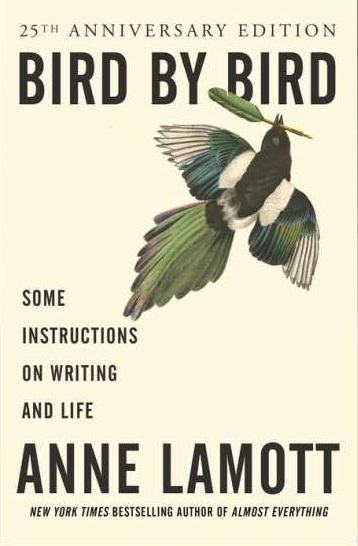
I thought if he can admit to being humiliated on page two of the book, I can admit my struggle about second drafts. I love writing “shitty first drafts," Lamott’s term in her most famous book, Bird by Bird: Some Instructions on Writing and Life. The freewriting process where anything that pops into my mind goes on the page is fun for me. If I write something I like or think might be good, I’ll put a perpendicular line in the margin and go back and type those words into my computer.
I dislike when it is time to start to organize those thoughts. I feel lazy, fuzzy brained, and not smart enough. I procrastinate. I’ve been known to pick dust out of the corners of the carpet in my office. When Allen said he was ashamed, I felt better about stalling in the early part of working on a second draft. I reminded myself that the resistance is part of my process. Once I get some reasonable order in place, I get over it, so there's really no reason to beat myself up about my procrastination.
When I finished reading their book, I was editing an essay and these rules I remembered with only one reading of the book influenced me as I was working on a second draft:
- Use and love a thesaurus to find better verbs than you had in your first draft. Example: “’We tried to go a week without Internet” could be “We hunkered down for a week without Internet.”
- But stop trying to find synonyms for “He or she said.” No one pays attention to them, and it is the best way to indicate someone is talking.
- Don’t show off and use words that people will have to look up. Recently I was working on a piece and the word deleterious popped in my head. I knew the tone was not right for the story, so I changed it to harmful.
- Replace words like—this, it, very. He quoted William Allen White, an early 20th century editor, “If you feel the urge of ‘very’ coming on, just write the word ‘damn,’ in the place of ‘very.’ The editor will strike out the word ‘damn,’ and you will have a good sentence.”
- Don’t repeat significant words close together. I’m working on my memoir and was writing a chapter about when my mother died. I had used the word “casket” twice in one paragraph. I changed one of them.
After I finished applying the rules that stuck in my head with a first reading, I reread the list of 36 rules multiple times. Allen’s 34th rule is “Break the rules.” When you’ve learned all of the rules and practiced them, then consider breaking one if it seems best for your piece but then go back to following it when you work on your next draft.
The last rule is “Worship (Talented) Editors.” Lamott said, “It is no exaggeration to say good editors are 30 percent of the reason you love the writers you do.” I am fortunate to have my daughter and my writing group as editors. They push me to do better but never so far that I feel dejected, and they make changes that honor my story and my voice. Neal and Lamott always read each other’s drafts to make the sentences stronger. Lamott said, “Almost every writer needs a partner who can look at your work with fresh eyes—you are either going to be bored with your work by the second draft and need encouragement and / or advice, or, worse, think it’s just fine and quite ready to send off to your editor that moment.”
Lamott and Neal emphasize that the 36 rules are not for first drafts or freewriting. She says we must all do anything you can to get words on paper or the screen and then polish them by applying all the rules that are appropriate. I plan to pull out the list regularly to help me be more cheerful about editing a second draft.


Comments
Our Comment Policy:
Our blog posts are only half of the conversation. What our readers have to say is equally important to us, and we're grateful for all the comments that continue the dialog.
To ensure that the discussion here is as useful as possible to all of our readers, please be respectful of our contributors and refrain from harassing, threatening and/or vulgar language. We reserve the right to screen and remove any comments from the site. If you have a question about a comment or want to discuss our policy, please contact us. We'll talk it over.
There are no comments for this entry yet.